
Quick Answer: Obesity Medicine Johannesburg: Treating Obesity as a Chronic Disease What is obesity medicine, and how is it different from standard weight-loss advice? Obesity medicine is a distinct medical specialty, separate…
Obesity Medicine Johannesburg: Treating Obesity as a Chronic Disease
What is obesity medicine, and how is it different from standard weight-loss advice?
Obesity medicine is a distinct medical specialty, separate from standard general practice, dedicated to the diagnosis and management of obesity as a chronic disease. South Africa does not yet have a formal subspecialty registration for obesity medicine, which means most patients receive generic weight-loss advice from doctors without specific training in the field. Dr Nick Petropoulos holds international obesity medicine training in addition to more than 15 years of clinical experience, and practises obesity medicine as a dedicated specialty at Equilibrium Health, Modderfontein.
Where general advice typically focuses on diet and exercise alone, obesity medicine investigates the underlying biochemical, hormonal, neurological, and inflammatory drivers of weight gain in each individual patient, then builds a treatment plan around what is actually driving that person’s disease.
A bio-psychosocial approach to obesity: biology, behaviour and environment
Obesity does not have a single cause, and it cannot be addressed from a single angle. At Equilibrium Health, we work from a bio-psychosocial model: the understanding that weight is shaped by the interaction of biological factors (genetics, hormones, inflammation, gut health), psychological factors (stress, sleep, mood, and eating behaviour) and social factors (access to food, culture, support systems and daily environment).
Treating only the biological piece (medication without support) ignores the psychological and social drivers that often determine whether a treatment plan is sustainable. Treating only behaviour — willpower-based diet advice — ignores the biological drivers that make some patients’ hunger and metabolism fundamentally different from others’. This is also why Equilibrium Health is built as a multidisciplinary practice: Dr Petropoulos addresses the medical and biochemical picture, our dietitian addresses nutrition and sustainable behaviour change, and a physiotherapist supports the physical side of the journey as weight and activity levels change.
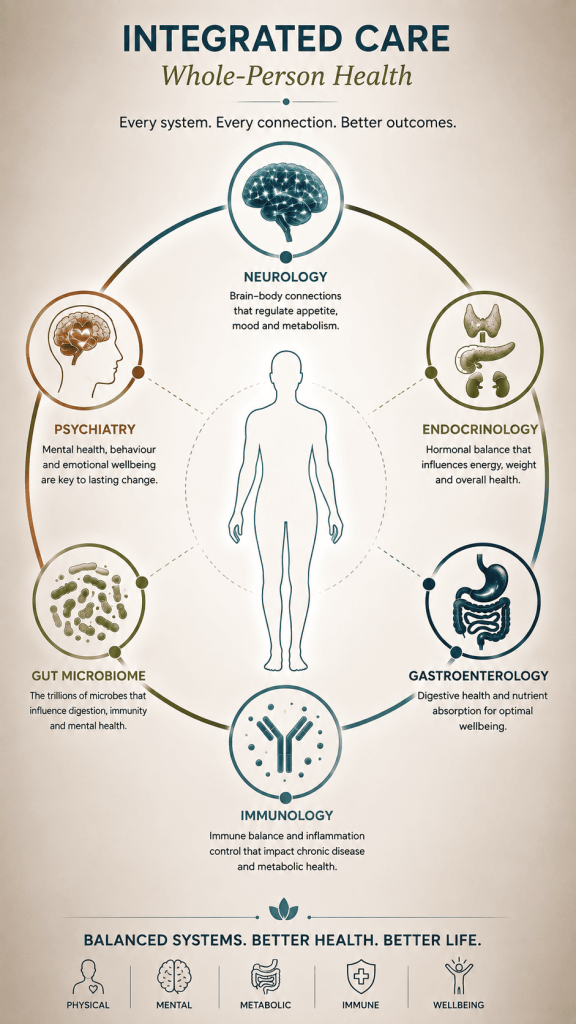
The Clinical Foundations Behind Obesity Medicine
Practising obesity medicine well draws on several fields that sit outside standard general practice training:
Pathophysiology
Understanding obesity at the level of disease mechanism, not just symptoms, how excess adiposity disrupts the body’s normal regulatory systems over time.
Neurology
Appetite, satiety, and reward are governed by specific neurological pathways. In obesity, these pathways are frequently disrupted: leptin, the hormone that signals fullness to the brain, often stops functioning correctly, so the brain continues to perceive hunger even when the body has sufficient energy stores. Understanding this is what separates ‘eat less’ advice from an actual treatment plan.
Obesity Medicine Endocrinology
Weight regulation is governed by a network of hormones, namely insulin, leptin, ghrelin, GLP-1, thyroid hormone and sex hormones among them. This involves assessing how these systems are functioning in an individual patient, including how they shift with conditions like insulin resistance or after menopause.
The Gut Microbiome
The bacteria living in the digestive tract influence how efficiently the body extracts and stores energy from food, and interact directly with the hormonal and inflammatory systems involved in weight regulation. Gut health is an increasingly well-evidenced part of the obesity picture.
Immunology
As fat tissue expands, fat cells become dysfunctional and begin releasing pro-inflammatory signals. This chronic, low-grade inflammation contributes directly to insulin resistance and further weight gain, creating a self-reinforcing cycle that plain dietary advice does not interrupt.
Nutrition-Based Medicine
Nutrition is applied clinically, not just as general healthy-eating advice, but as a targeted part of an individual patient’s treatment plan, delivered in partnership with our registered dietitian, Charne Smit, and adjusted as metabolic markers change.
Keeping weight off: how we approach weight maintenance
Losing weight and keeping it off are not the same clinical problem, and they are not treated the same way at Equilibrium Health. The initial phase of treatment, whichever combination of pharmacotherapy, nutrition and lifestyle change it involves, is only ever half of the plan. The other half is deliberately building the skills, knowledge and dietary discipline a patient needs to maintain their results once goal weight is reached, including for patients who choose to come off medication rather than remain on it indefinitely.
In practice, this means nutrition education and habit-building run alongside treatment from the first consultation, not as an afterthought once a target is hit. It means a structured, monitored plan for any transition off medication, rather than simply stopping and hoping. And it means measuring success not only in kilograms lost, but in whether a patient has the tools to sustain that result years later. This is the long game obesity medicine is actually playing, and it is the standard Equilibrium Health is built around.
What happens at your first obesity medicine consultation
An obesity medicine consultation begins with a comprehensive metabolic assessment, including body composition analysis using InBody technology and relevant blood markers, before any treatment: lifestyle-based, pharmacological, or both, is recommended. The result is a plan built around what is actually driving your individual weight, not a generic programme.
Frequently asked questions
What is Obesity Medicine?
Obesity Medicine in Johannesburg Dr Nick Petropoulos | Equilibrium Health Obesity medicine is the clinical specialty that treats obesity as a chronic, multifactorial disease, not a matter of willpower. At Equilibrium Health, that means assessing every biological system involved in…
Why can't I lose weight even though I eat well and exercise?
This is a common presentation with identifiable biological causes: leptin resistance, insulin resistance, chronic low-grade inflammation, hormonal shifts, and more. The simple ‘calories in, calories out’ model doesn't account for these. A proper metabolic assessment identifies which mechanism is dominant for you.
What is the bio-psychosocial model of obesity?
It's the understanding that obesity results from the interaction of biological, psychological and social factors, which is why effective treatment addresses more than diet and exercise alone.
Do I need to see a psychologist as part of obesity medicine treatment?
Not necessarily. The bio-psychosocial model means psychological and social factors are considered as part of your assessment; a referral is made only if it would genuinely help your specific situation.
Is obesity medicine only for patients with a very high BMI?
No. Obesity medicine is relevant for anyone whose weight or metabolic health is affected by the biological drivers described above, regardless of where they currently sit on the BMI scale, since BMI alone doesn't capture metabolic risk.