
Quick Answer: Publications & Evidence-Based Medicine | Dr Nick Petropoulos | Equilibrium Health Every treatment recommendation at Equilibrium Health is grounded in published, peer-reviewed research, not trends or anecdote. Publications &…
Publications & Evidence-Based Medicine | Dr Nick Petropoulos | Equilibrium Health
Every treatment recommendation at Equilibrium Health is grounded in published, peer-reviewed research, not trends or anecdote. Dr Nick Petropoulos brings an academic grounding in biochemistry to obesity medicine and stays closely engaged with the evolving evidence base, particularly the evidence on what actually keeps weight off long-term, not just what takes it off.

An Academic Approach to Obesity Medicine
Dr Nick Petropoulos’s path into medicine began with a Master’s degree in biochemistry, ahead of his MBChB at the University of the Witwatersrand, a foundation that still shapes how he approaches weight and metabolism today: biochemistry first, willpower second. That academic grounding carries through into how the practice is run: treatment decisions are drawn from current, published research and reassessed as the evidence evolves, not from trends.
Precision, Individualised Care
Dr Andres Acosta and colleagues at the Mayo Clinic’s Precision Medicine for Obesity Laboratory have shown that obesity is not a single disease, but several distinct biological patterns, or phenotypes: including impaired satiety signalling (‘hungry brain’), abnormal post-meal fullness (‘hungry gut’), emotional eating, and reduced energy expenditure (‘slow burn’). In a 2021 pragmatic trial published in the journal Obesity, patients whose treatment was matched to their specific phenotype achieved meaningfully greater weight loss than those on standard, undifferentiated care. This body of research is part of why every new patient at Equilibrium Health begins with a full metabolic assessment rather than a standard prescription and why maintenance plans are built around the individual, not a template.
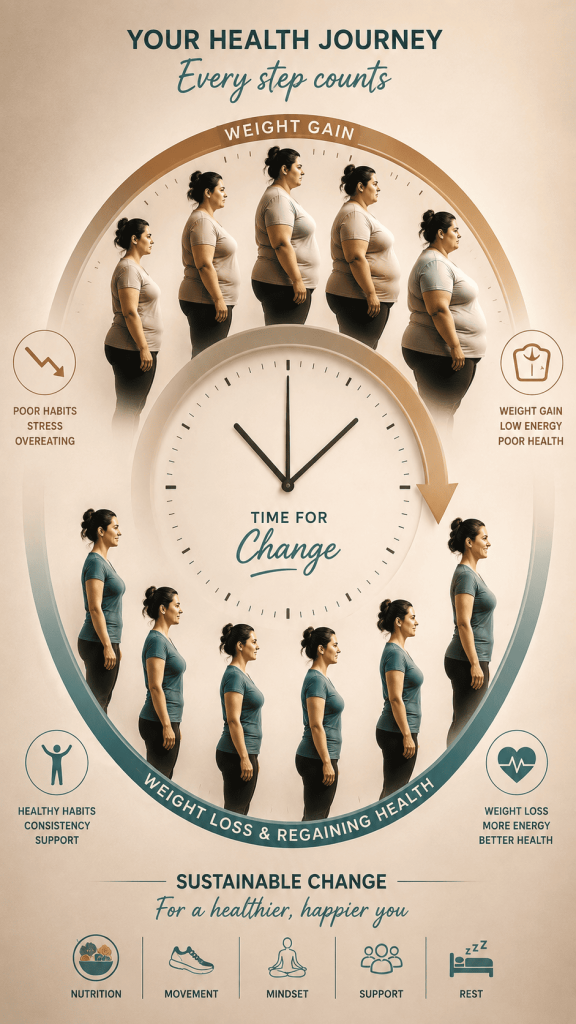
The Evidence That Matters Most: What Happens After Weight Loss
Most obesity research focuses on how much weight a treatment removes. The more clinically important question and the one that shapes how Equilibrium Health is run — is what happens afterwards.
The STEP 1 trial (New England Journal of Medicine, 2021) showed that semaglutide, combined with lifestyle intervention, produced an average weight loss of 14.9% over 68 weeks, against 2.4% on placebo. A follow-up analysis of the same participants found something equally important: once semaglutide was stopped, participants regained the majority of the weight they had lost within a year and the cardiometabolic improvements they had gained largely reverted too.
This is not a reason to avoid GLP-1 therapy. It is the reason Equilibrium Health does not treat it as a standalone prescription. Medication can create the metabolic conditions for change; it cannot, on its own, build the skills, habits and knowledge a patient needs to sustain that change once treatment ends, or once a patient chooses to come off medication after reaching their goal. That work: structured nutrition education, an individualised maintenance plan and ongoing monitoring through the transition — is built into the programme from the first consultation, not added on afterwards.
SURMOUNT-5 (2025): a head-to-head trial comparing tirzepatide with semaglutide found greater average weight loss with tirzepatide, informing how Dr Petropoulos selects between the two therapies for individual patients.

What Sustained Change Actually Requires
Two of the longest-running bodies of evidence in lifestyle medicine — the Pritikin Program and Dr Dean Ornish’s research — point to the same conclusion from a different angle: change that lasts is change that is practised, not prescribed.
Dr Dean Ornish’s randomised Lifestyle Heart Trial, published in JAMA and The Lancet, found that patients following an intensive lifestyle programme showed measurable reversal of coronary artery narrowing after one year and even greater improvement after five years — evidence that sustained lifestyle discipline compounds over time rather than fading. A related study found that just three months of intensive lifestyle change altered the activity of around 500 genes, evidence that consistent habits, not a single event, drive lasting physiological change.
The Pritikin Program’s evidence base (more than 100 published clinical studies since the 1970s) points the same way: benefits tracked closely with how consistently its dietary and activity principles were maintained, not simply whether they were started.

What This Means for Your Care
None of this evidence guarantees any individual outcome. Results vary from person to person and every treatment plan at Equilibrium Health is based on your own metabolic assessment. What it does establish is why Equilibrium Health is built the way it is: an initial phase focused on the medical and metabolic groundwork, and, running alongside it from day one, the nutrition education, lifestyle coaching, and monitoring that give you the tools to maintain your results long after any medication, or any active treatment phase, ends.
Frequently asked questions
What is Publications?
Publications & Evidence-Based Medicine | Dr Nick Petropoulos | Equilibrium Health Every treatment recommendation at Equilibrium Health is grounded in published, peer-reviewed research, not trends or anecdote. Dr Nick Petropoulos brings an academic grounding in biochemistry to obesity medicine and…